Biology Diversity and Conservation Continued Ws
Read and download free pdf of CBSE Class 12 Biology Biodiversity And Conservation Worksheet Set A. Students and teachers of Class 12 Biology can get free printable Worksheets for Class 12 Biology in PDF format prepared as per the latest syllabus and examination pattern in your schools. Standard 12 students should practice questions and answers given here for Biology in Grade 12 which will help them to improve your knowledge of all important chapters and its topics. Students should also download free pdf of Class 12 Biology Worksheets prepared by school teachers as per the latest NCERT, CBSE, KVS books and syllabus issued this academic year and solve important problems provided here with solutions on daily basis to get more score in school exams and tests
Biodiversity And Conservation Class 12 Biology Worksheet Pdf
Class 12 Biology students should refer to the following printable worksheet in Pdf for Biodiversity And Conservation in standard 12. This test paper with questions and answers for Grade 12 Biology will be very useful for exams and help you to score good marks
Class 12 Biology Worksheet for Biodiversity And Conservation
Important Questions for NCERT Class 12 Biology Biodiversity and Conservation
Question. When we conserve and protect the whole ecosystem, its biodiversity at all levels is called -
(a) In situ conservation
(b) Ex -situ conservation
(c) On site conservation
(d) Both (a) and (c)
Answer : D
Question. Which statement is incorrect -
(a) There is increase in biodiversity from pole to equator
(b) There is increase in biodiversity from low altitude to high altitude
(c) There is directly proportional relationship between area & biodiversity
(d) Tropics has less seasonal, relatively more constant and predictable environment.
Answer : B
Question. In equation log S = log C + Z log A, what is Z -
(a) Species richness
(b) Area
(c) Regression coefficient
(d) Y-intercept
Answer : C
Question. For frugivorous birds and mammals in tropical forest of different continents, the slope(Z) is found to be :-
(a) 0.1 - 0.2
(b) 0.6 - 1.2
(c) 1.15
(d) 11.5
Answer : C
Question. Select the wrong match for extinction of species as per the IUCN red list 2004 -
(a) Vertibrates - 338
(b) Invertebrates - 359
(c) Plants - 87
(d) Prokaryotes - 2001
Answer : D
Question. According to ecologists warn that if the present trends continue. Nearly half of the species on earth might be wiped out within how many years -
(a) 100
(b) 1000
(c) 50
(d) 500
Answer : A
Question. In general, the loss of biodiversity in a region may not lead to -
(a) Decline in plant production
(b) Lowered resistance to environmental perturbations
(c) Constant pest and disease cycles
(d) Increased variability in certain ecosystem processes such as plant productivity
Answer : C
Question. Find out the right one -
(a) India has 7.1% species diversity
(b) India is one of the 22 mega diversity countries of world
(c) According to Robert May's global estimate only 22% of the total species have been recorded so for
(d) According to Robert May's estimation, more than 3,00,000 plant species yet to be discovered in India
Answer : C
Ques. Consider the following statements (A – D) each with one or two blanks.
(A) Bears go into (1) during winter to (2) cold weather.
(B) A conical age pyramid with a broad base represents (3) human population.
(C) A wasp pollinating a fig flower is an example of (4) .
(D) An area with high levels of species richness is known as (5) .
Which one of the following options, gives the correct fill ups for the respective blank numbers from (1) to (5) in the statements ?
(a) (3) – stable (4) – commensalism, (5)-marsh
(b) (1) – aestivation, (2) – escape, (3) – stable, (4) – mutualism
(c) (3) – expanding, (4) – commensalism, (5) – biodiversity park
(d) (1) – hibernation, (2) – escape, (3) – expanding (5) – hotspot
Answer: D
Ques. Which one of the following is an example of ex-situ conservation?
(a) Wildlife sanctuary
(b) Seed bank
(c) Sacred groves
(d) National park
Answer: B
Ques. Tiger is not a resident in which one of the following national parks?
(a) Sunderbans
(b) Gir
(c) Jim Corbett
(d) Ranthambhor
Answer: B
Ques. Which one of the following is not observed in biodiversity hotspots?
(a) Lesser inter-specific competition
(b) Species richness
(c) Endemism
(d) Accelerated species loss
Answer: A
Ques. World Summit on Sustainable Development (2002) was held in
(a) Argentina
(b) South Africa
(c) Brazil
(d) Sweden.
Answer: B
Ques. Identify the odd combination of the habitat and the particular animal concerned.
(a) Sunderbans – Bengal Tiger
(b) Periyar – Elephant
(c) Rann of Kutch – Wild Ass
(d) Dachigam – Snow Leopard National Park
Answer: D
Ques. Which of the following is considered a hotspot of biodiversity in India?
(a) Aravalli hills
(b) Western ghats
(c) Indo-gangetic plain
(d) Eastern ghats
Answer: B
Ques. Which one of the following is not included under in situ conservation?
(a) National park
(b) Sanctuary
(c) Botanical garden
(d) Biosphere reserve
Answer: C
Ques. Which one of the following is the correctly matched pair of an endangered animal and a national park?
(a) Great Indian bustard : Keoladeo National Park
(b) Lion : Corbett National Park
(c) Rhinoceros : Kaziranga National Park
(d) Wild ass : Dudhwa National Park
Answer: C
Ques. Biodiversity Act of India was passed by the Parliament in the year
(a) 1992
(b) 1996
(c) 2000
(d) 2002.
Answer: D
Ques. In your opinion, which is the most effective way to conserve the plant diversity of an area?
(a) By tissue culture method
(b) By creating biosphere reserve
(c) By creating botanical garden
(d) By developing seed bank
Answer: B
Ques. Viable material of endangered species can be preserved by
(a) gene bank
(b) gene library
(c) herbarium
(d) gene pool.
Answer: A
Ques. MAB stands for
(a) mammals and biosphere
(b) mammals and biology programme
(c) man and biology programme
(d) man and biosphere programme.
Answer: D
Ques. Identify the correct match between tiger reserve and its state.
(a) Manas - Assam
(b) Corbett - Madhya Pradesh
(c) Bandipur - Tamil Nadu
(d) Palamu - Odisha
Answer: A
Ques. Which of the following is the matching pair of a sanctuary and its main protected wild animal?
(a) Kaziranga-Musk deer
(b) Gir-Lion
(c) Sunderban-Rhino
(d) All of these
Answer: B
Very Short Answer Type Questions
Question. What does 'Red' indicate in the IUCN Red list (2004)?
Answer : Red in the IUCN Red list (2004) refers to the taxa with the highest risk of extinction.
Question. What is common to the species shown in figures A and B?
Answer : Both the species are conserved in their natural habitats.
Question. What could have triggered mass extinctions of species in the past?
Answer : Nobody knows the real reason but the scientists believe that any one of the following could have triggered mass extinction of species in the past.
(i) Fall of sea levels. (ii) Change in temperature (freezing or warming).
(iii) Asteroid/meteorite hitting the planet.
(iv) Poisonous hydrogen sulphide emissions from the sea.
(v) Nova/super nova/gamma ray burst.
(vi) Plate tectonics.
Question. Why is genetic variation important in the plant Rauwolfia vomitoria?
Answer :Plant Rauwolfia vomitoria is a source of drug reserpine which acts as tranqulliser. Genetic variation shown by this medicinal plant might be in terms of the potency and concentration of active chemical (resperin) that plant produces.
Question. What is Red Data Book?
Answer :Red Data Book is a compilation of data or records of species threatened with risk of extinction (which are known to be endangered). The book is maintained by IUCN (headquartered at gland in Switzerland).
Question. Define gene pool.
Answer : Gene pool refers to the sum total of all genes of every individual in an inbreeding population.
Question. What does the term 'Frugivorous' mean?
Answer : Frugivorous term is used for those animals which eat only fruits or eat fruit as their staple diet.
Question. What is the expanded form of IUCN?
Answer : IUCN stands for 'International Union for Conservation of Nature and Natural Resources'. Its headquarters are situated at gland in Switzerland.
Short Answer Type Questions
Question. Discuss one example, based on your day-to-day observations, showing how loss of one species may lead to the extinction of another.
Answer : Co-extinction is the extinction of two mutually related or interelated species for instance a host fish extinction leads to the extinction of all those parasites exclusively found on it. Another example is plant pollinator mutualism, where extinction of one leads to the extinction of other. Insect, aphids are polyphagous (feed on more than one plant species) or monophagous (feed on a particular species of plant). Monophagous insects may become extinct, if the plant species upon which they feed becomes extinct.
Question. A species area curve is drawn by plotting the number of species against the area. How is it that when a very large area is considered the slope is steeper than that for smaller areas ?
Answer : In very large areas, the number of species is much more that is why the curve is much steeper. This is because the larger area has more, food availability and other resources, so obviously more species may thrive.
Question. Is it true that there is more solar energy available in the tropics? Explain briefly.
Answer : Yes, There is more solar energy available in the tropics because
(i) The sun's rays are more concentrated.
(ii) The sun's rays have less atmosphere to pass through, so less energy is lost in absorption and reflection by the atmosphere.
(iii) Tropical rainforest areas absorbs radiations due to presence of dense vegetation. Availability of more solar energy in tropics contribute higher productivity which in turn might contribute greater maximum biodiversity.
Question. What is co-extinction? Explain with a suitable example?
Answer :When a species becomes extinct, the plant and animal species associated with it, in an obligatory way, also become extinct, e.g., when a host fish species becomes extinct, its parasites also vanish. This is called co-extinction. Some other examples of co-extinction are; plant-pollinator mutualism where extinction of one leads to the extinction of other. Monophagous insect that feeds on particular plant species becomes extinct due to extinction of that plant species.
Question. Why are the conventional methods not suitable for the assessment of biodiversity of bacteria?
Answer : Many bacteria cannot be cultured under normal conditions in vitro, which creates a problem in studying their morphological and biochemical characteristics. Morphology and biochemistry along with some other characteristics are used for the assessment of biodiversity of bacteria. Thus, conventional methods are not suitable for the assessment of biodiversity of bacteria.
Question. What criteria should one use in categorising a species as threatened?
Answer :The criteria that should be used in categorising a species as threatened are
(i) Number of the members of the species are declining at an alarming rate.
(ii) Their habitat is being modified or destroyed.
(iii) Predator or poacher activities are increasing.
Question. What could be the possible explanation for greater vulnerability of amphibians to extinction as compared to other animal groups?
Answer : Amphibians are more vulnerable to extinction
(i) Habitat Modification or Destruction Amphibians generally need aquatic and terrestrial habitats to survive; threats to either habitat can affect populations. Hence, amphibians may be more vulnerable to habitat modification than organisms that require only one habitat type.
(ii) Habitat Fragmentation This means isolation of a few areas by habitat modification. Small populations that survive within such fragments are often susceptible to inbreeding, genetic drift or extinction due to small fluctuations in the environment.
(iii) Large Scale Climate Changes These changes can further modify aquatic habitats, preventing amphibians from spawning.
Question. How is the presently occurring species extinction different from the earlier mass extinctions ?
Answer :In earlier time extinction of species occurred due to natural causes or calamities like flood, volcanic eruption, prolonged drought and landslides, etc. While at present human activities are the major cause of species extinction.
Long Answer Type Questions
Question. Can you think of a scientific explanation, besides analogy used by Paul Ehrlich, for the direct relationship between diversity and stability of an ecosystem?
Answer : Scientific explanation for the direct relationship between diversity and stability of an ecosystem could be as follows Imagine a forest area, where diverse species of plants are growing. Plants harbour a variety of insects on which a lot of bird species would depend for their food. If a specific plant species dies, the related insect population will be affected that would lead to food unavailability for the birds. In addition, if the plant species was a nitrogen fixer, the death of these plants would mean no replenishment of soil with nitrogen. This will obviously affect the other plants as well. So, if the cycle continues, the whole habitat/ecosystem will be negatively affected.
Question. The relation between species richness and area for a wide variety of taxa turns out to be a rectangular hyperbola. Give a brief explanation.
Answer : According to AV Humboldt, a German scientist within, a region, species richness increased with increasing explored area (only upto a limit). Accordingly the relation between species richness and area for a wide variety of taxa (birds, bat, angiosperms, aquatic fishes) turns out to be a rectangular hyperbola. The relationship depicts a straight line on a logaithimic scale described by the following equation log S = log C + Z log A Where, 'S' stands for species richness, 'A' is area and 'Z' and 'C' are slope of line (regression coefficient) and y intercept respectively. (Image 275)
Question. Though the conflict between humans and wildlife started with the evolution of man, the intensity of conflict has increased due to the activities of modern man. Justify your answer with suitable examples.
Answer : The humans first evolved around 2.5 million years ago and agriculture began about 11 thousand years ago. It is since then that humans have started to exploit the forest land for agriculture. Development in medical technology has increased the lifespan of humans, decreased the mortality rate of mother and child, further aggravating the problem of human population. Along with this, the industrial revolution caused enormous consumption of earth's resources but giving back nothing. The monumental amount of waste is destroying the natural habitat of other species, be it aquatic or terrestrial, endangering and later causing extinction thereof. This is how human activities have led to the increase in conflict between humans and wildlife.
Question. What is an ecosystem service? List any four important ecosystem services provided by the natural ecosystems. Are you in favour or against levying a charge on the service provided by the ecosystem?
Answer : Ecosystem Services The products of ecosystem processes are termed as ecosystem services. Forests are the major sources of ecological services. Some of the ecosystem services they provide are (i) Purification of air and water. (ii) Mitigating droughts and floods. (iii) Cycling nutrients. (iv) Generating fertile soils (v) Providing wildlife habitat. (vi) Maintenance of biodiversity. (vii) Pollination of crops. (vii) Providing storage site for carbon. (ix) Providing aesthetic, cultural and spiritual values. Robert Constanza and his colleagues tried to put price tags on nature's life support services, which was about US $ 33 trillion a year. No, i am not in favour of levying a charge on ecological services but it is very important, to understand how much nature is providing us for free and if we overuse or misuse its resources, we'll have to pay a heavy price for it.
Diversity at all levels of biological organisation Questions and Answers
Ques.A study of latitudinal gradient of biodiversity of birds is as follows:
India- 8 o North—1200 Species
Greenland-71 o North-55 Species
By analyzing the above data what does it indicate about the distribution of birds.
Answer : Species diversity decreases from equator towards the poles.
Ques.What favours the genetic variation shown by the medicinal plant Rauwolfia vomitoria growing in different Himalayan ranges ?
Answer : Genetic variation shown due to the potency and concentration of active chemical (reserpine) produced by the plant.
Ques.Why is Ecological diversity seen more in India as compared to Scandinavian country Norway.
Answer : As India is rich in various ecosystem level with deserts ,rain forest,mangroves,coral reef,wetlands,estuaries and alpine meadows so greater ecosystem diversity.
Ques. Match the following:
1.IUCN(2004) total number of plant animal species discovered so far ----7 million
2.Robert May estimate of global species diversity-----.5 million
3.70 % of all recorded are-----.1 %
4. Among animals the most rich species are----plants (algae, fungi, bryophytes, gymnosperm and angiosperms).
5.India has only 2.4 % of land area, its share of global species diversity is---- insects
Answer : Match the following:
1. IUCN (2004) total number of plant animal species described so far---- 1.5million
2. Robert May estimate of global species diversity----- 7 million
3. 70 % of all recorded are- ----plants(algae,fungi,bryophytes,gymnospers and angiosperms)
4. Among animals the most rich species are—---- insects
5. India has only 2.4 % of land area, its share of global species diversity is---- 8.1 %
Ques.Why are biologist not able to give the estimate of Prokaryotes in nature ?
Answer :Because the the conventional taxonomic methods are not suitable for identifying microbial species
Pattern of Biodiversity Questions and Answers
Ques. Answer in one word or one sentence
a) Why species diversity is more in India than in Greenland?
b) The scientist has found that the slope of line of regression is found to be more than 0.2. In which condition this will be possible?
Answer : Biodiversity decreases from equator to pole; When large areas like whole continent are taken for analysis.
Ques. Fill in the blank
a) The shape of graph in species area richness relationship in bats is -------------------.
b) Niche specialization thereby leading to greater species diversity in tropic is due to------------.
c) Frequent glaciations in temperate region leads to less-------------.
d) Species richness is related with-------------- up to a certain limit.
Answer :Rectangular hyperbola; More constant and predictable environment; Species diversification; area
Ques. Match the followings
1. Environment in temperate region. a) Steeper slope of line
2. More solar energy. b) More constant and more predictable.
3. Tropical latitudes c) Leads to more species diversity.
4. Constant environment d) More species diversification.
5. High regression coefficient e) More biodiversity.
Answer :1-b; 2-c; 3-e; 4-d; 5- a
Ques. Choose the correct answer
a)The slope of line in species area relationship graph is 1.15
a) Angiosperm plants
b) mammals
c) birds
d) fresh water fishes
Answer : B
b) Scientists have estimated that about two million insects species are yet to be discovered in
a) Greenland
b) Equador
c) Amazonian Rain forest
d) India
Answer : C
c) As we move from 41oN to 71oN, the species diversity
a) Increases
b) Decreases
c) Remain the same
d) Doubled
Answer : B
d) Frequent glaciations leads to
a) Increase species diversification
b) High productivity
c) Decrease species diversification
d) Niche specialization
Answer : C
Ques. The following graph depicts the species-area relationship. Answer the following questions
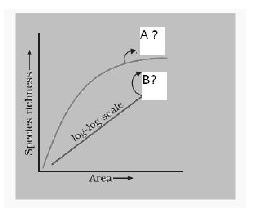
1) Give the equation of "A" and equation of 'B".
2) What does steeper slope in curve "B" represents?
3) Who studied the species – area relationship in South African jungles?
4) What does Z stands for? In which range does the normal value of Z lies?
Answer : S= CAZ ; log S= log C + Z log A ; Higher regression coefficient; regression coefficient, 0.1 to 0.2
Domestic sewage and industrial effluents Questions and Answers
Ques. Write scientific name of water hyacinth? why it is known as "terror of Bengal"?
Answer : Eichhornia crassipes. It results in eutrophication
Ques. Introduction of which nutrient in water bodies result eutrophication?
Answer : Nitrogen and phosphorus
Ques. Give reasons why there is a continuous increase in the DDT content in different trophic levels of the chain?
Answer :This happens because a toxic substance accumulated by an organism cannot be metabolized or excreted,and is thus passed on to the next higher trophical level.
Ques. What percentage of global warming is contributed by each of the following?
i)Carbon di oxide
ii)chlorofluorocarbons
iii)nitrous oxide and
iv) methane
Answer : i)60%, ii) 14%, iii)6%, iv) 20%
Ques. Ornithologists observed a decline in the bird population I the area near a lake after the setting of an industrial unit in the same area. explain the cause responsible for the decline observed?
Answer :High concentration of DDT interferes with calcium metabolism in birds and cause thinning of egg shells and their premature breaking,this eventually leads to a decline in bird population.
Please click the link below to download full pdf file for CBSE Class 12 Biology Biodivesity and Conservation (1) .
Source: https://www.studiestoday.com/printable-worksheet-biology-cbse-class-12-biology-biodivesity-and-conservation-1-225777.html
0 Response to "Biology Diversity and Conservation Continued Ws"
Post a Comment